Choosing the best Cup Sealing Film is not only a question of price or appearance. It affects hygiene, filling speed, leakage control, recycling, and customer trust.
The Smithers report, The Future of Global Packaging to 2028, values the global packaging market at more than one trillion U.S. dollars. It identifies convenience, sustainability, and material efficiency as major growth pressures. Meanwhile, PMMI research shows that food and beverage producers increasingly seek packaging equipment with higher automation and lower material waste. These trends reach the sealing station directly. A film must run smoothly, seal consistently, and open without spraying yogurt across a customer’s desk.
There is no perfect film.
Ellen MacArthur, a leading circular-economy authority, said, “We need to move from a take-make-dispose model to one that is restorative and regenerative by design.” Her principle matters when comparing PET, PP, PE, aluminum, and multilayer structures. Barrier performance can protect freshness, but complex layers may complicate recovery. A thinner film may reduce material use, yet it can tear during transport. The cheapest option may create costly rejects, downtime, or customer complaints.
This guide examines sealing temperature, peel strength, oxygen and moisture barriers, print quality, equipment compatibility, and end-of-life claims. It also considers real production details, such as a cold cup rim, a dusty sealing area, or a film roll stored in humid conditions. Some recommendations will remain conditional. Your product, machine, and local recycling system may change the answer. That uncertainty deserves attention, not polished promises.
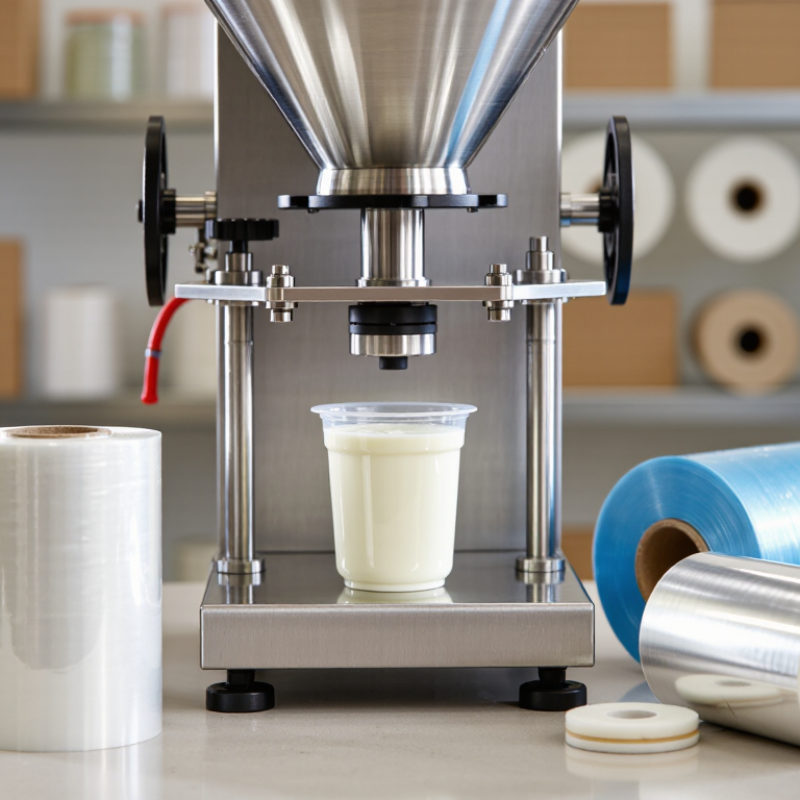
Choosing a sealing film starts with identifying the cup material. The film must bond with the cup rim, not merely cover it. PP cups tolerate moderate heat and often need a PP-compatible sealing layer. PET cups provide clarity and stiffness, but their sealing surface still requires careful matching. PS cups are rigid and sensitive to excessive heat. PE cups are flexible, so film stretch and sealing pressure need closer control. Material matching matters.
The film’s heat-seal layer should suit both the resin and the filling process. For PP, stable sealing at controlled temperatures helps prevent rim distortion. PET may need a film designed for reliable bonding without damaging its clear surface. PS usually benefits from lower heat and shorter dwell time. PE can require flexible films that follow slight cup deformation. Cold fillings may create condensation, reducing seal strength. Test the actual pair.
Fill conditions can change the result quickly. A dairy product may leave a thin, oily layer on the rim. A sauce can leave particles near the sealing area. Measure seal strength after filling, not only with clean empty cups. Check opening force, leaks, wrinkles, and storage performance. Real lines are less forgiving. A perfect laboratory seal may fail during a fast production run. The first trial may be wrong. That is useful. Adjust temperature, pressure, and dwell time together.
Choosing cup sealing film starts with its seal-initiation temperature, or SIT. For many heat-sealable structures, the useful range is 110–140°C. A lower SIT can reduce energy use and protect thin cups. However, it may narrow the process window. A higher SIT may tolerate handling better, but it can slow production and distort sensitive plastics.
Hot tack matters just as much. It measures seal strength while the seal is still hot. This is critical when a freshly sealed cup moves immediately through stacking, cartoning, or filling lines. In practical trials, compare films at 110°C, 120°C, 130°C, and 140°C. Record peel strength, leakage, seal width, and failure mode. Test with clean rims and with realistic contamination, such as a thin ring of yogurt or sauce. The result can change quickly.
Smithers’ 2024 flexible packaging outlook estimates the market will approach US$300 billion by 2028. That growth increases pressure for faster, lighter, and more reliable packaging. A 2024 Grand View Research analysis also forecasts roughly 5% annual growth for flexible packaging through 2030. These figures support careful film selection, not automatic acceptance of the cheapest option. I would not choose the lowest SIT without checking hot tack at line speed. That was a weak assumption in an early trial. Laboratory results looked excellent, yet the production conveyor produced lifted corners. Sealant selection should follow ASTM F1921 and F88 testing, plus real machine trials. Perfect data can still miss imperfect factory conditions.
Choosing the best cup sealing film starts with the product’s real protection needs, not appearance alone. Moisture-sensitive powders, dairy products, and chilled desserts may require different barrier levels. Set a target for water vapor transmission rate (WVTR) and oxygen transmission rate (OTR) before comparing film structures.
WVTR testing helps measure how much moisture passes through the film over time. ASTM F1249 uses a modulated infrared sensor and controlled humidity conditions. OTR testing measures oxygen movement through the film. ASTM D3985 commonly uses a coulometric sensor under specified temperature and humidity settings. Ask an experienced laboratory to report the test temperature, relative humidity, film thickness, and test area. Without these details, two results may look comparable but describe different conditions.
Barrier performance is only one part of cup sealing reliability. During production trials, inspect seal width, peel behavior, wrinkles, pinholes, and edge contamination. A film with excellent laboratory data can still fail when the sealing temperature is unstable. I have seen attractive seals hide weak corners. That mistake is easy to miss. Test filled cups through storage and transport simulations, then compare the results with your WVTR and OTR targets. It may also be necessary to adjust the target after reviewing actual product sensitivity, filling conditions, and expected shelf life. Some assumptions will be wrong. That is useful evidence.
How to Choose the Best Cup Sealing Film for Your Business?
Food-contact compliance should guide your film selection, not just seal strength or price. For the United States, check the applicable FDA 21 CFR requirements for every layer, including plastic, adhesive, ink, and coating. The correct section depends on the film’s material and intended food use. Ask for a current compliance statement and supporting migration data. Do not treat a generic certificate as sufficient proof.
For the European market, verify compliance with Regulation (EC) No 1935/2004. The film must not transfer substances that endanger health, change food composition, or affect taste and odor. Its production should also follow suitable good manufacturing practices. Request traceability records and a Declaration of Compliance when relevant. Check whether the film touches acidic, fatty, frozen, or hot foods.
Details matter.
During packaging reviews, teams often check the base film but overlook printing ink or adhesive contact. That mistake can create uncertainty later. I would question any supplier document that lacks test conditions, food categories, or temperature limits. Real use may differ from laboratory assumptions. A film tested for cold water may not suit hot soup. Review the sealing temperature, storage time, and cup material together. Keep batch records, test reports, and updated declarations accessible before production begins.
| Evaluation Dimension | FDA 21 CFR Considerations | EU Regulation 1935/2004 Considerations | What to Request from the Film Supplier |
|---|---|---|---|
| Regulatory framework | Food-contact compliance is determined by the applicable FDA authorization, such as a relevant section of Title 21 CFR, a food-contact notification, or another valid authorization route. | Regulation (EC) No 1935/2004 establishes the general safety and inertness requirements for materials intended to contact food. Specific material rules may also apply. | A written declaration identifying the legal basis, material composition, intended food-contact use, and applicable limitations. |
| Material identification | The film polymer and additives must be covered by an applicable FDA authorization for the intended conditions of use. A generic statement such as “food grade” is not sufficient evidence by itself. | For plastic layers, Commission Regulation (EU) No 10/2011 may apply, including its Union list of authorized substances and restrictions. Other layers may be subject to additional national or EU measures. | Full layer structure, polymer types, adhesive and ink status, additives subject to restrictions, and the applicable regulatory references. |
| Food type compatibility | Confirm suitability for the actual food category, including aqueous, acidic, alcoholic, fatty, or dry foods, as applicable to the authorization and test conditions. | Migration and use limitations depend on the food simulant or food type, contact conditions, and restrictions listed in the applicable EU legislation. | A completed intended-use matrix showing compatible food types and any exclusions, such as high-fat or highly acidic products. |
| Temperature and time of contact | The film must be evaluated under the applicable temperature and contact-time conditions, including filling, hot sealing, refrigeration, freezing, or reheating where relevant. | The intended conditions of use must be covered by the declaration and supporting migration assessment, including time, temperature, and repeated-use conditions where applicable. | Maximum continuous-use temperature, sealing temperature range, allowable contact duration, and evidence for refrigerated, frozen, hot-fill, or reheating applications. |
| Overall migration or extractables | Testing should support compliance with the applicable FDA authorization and the intended conditions of use. The exact testing approach depends on the material and authorization route. | For plastic materials within the scope of Regulation (EU) No 10/2011, the overall migration limit is generally 10 mg/dm², subject to the regulation and applicable exceptions. | Migration-test reports showing laboratories, methods, simulants, time, temperature, sample construction, and results relevant to the final film structure. |
| Specific migration and restricted substances | Check substance-specific restrictions, residual monomers, additives, colorants, adhesives, and printing-ink components under the applicable FDA authorization. | Specific migration limits, residual content limits, and other restrictions may apply to listed substances under Regulation (EU) No 10/2011 or other relevant measures. | Substance compliance statement, restricted-substance assessment, and test results for substances relevant to the film’s formulation. |
| Multilayer construction | Every food-contact layer, adhesive, coating, ink, and functional barrier should be assessed for its role and potential transfer into food. | The declaration should cover the complete composition and explain any functional barrier or non-food-contact layer, where such a concept is used. | A cross-sectional structure diagram, layer thicknesses, adhesive and ink information, and compliance evidence for the finished laminate rather than only one layer. |
| GMP and manufacturing controls | The supplier should operate suitable controls to prevent contamination, formulation errors, and mix-ups. The specific FDA food-contact authorization remains the key compliance basis. | Commission Regulation (EC) No 2023/2006 on good manufacturing practice applies to materials and articles intended to contact food. | Quality-management information, batch traceability, change-control procedures, hygiene controls, and relevant audit or certification records. |
| Declaration of compliance | A supplier compliance letter should clearly identify the applicable FDA authorization and conditions of use. The document should be specific to the supplied construction. | A written Declaration of Compliance is required for relevant plastic materials and should provide sufficient information for downstream users to verify compliance and define use conditions. | Current, signed documentation with revision date, product code, intended use, legal references, limitations, and contact details for technical support. |
| Sealing performance | Regulatory compliance does not guarantee that the film will seal correctly on a particular cup. Seal integrity must be validated on the actual packaging line. | The same principle applies: food-contact compliance and package-performance validation are separate requirements. | Recommended sealing-temperature window, dwell time, pressure, peel strength, leak-test results, and performance data using the intended cup material. |
| Printing and consumer-facing side | Printing inks and coatings must be controlled to prevent unacceptable transfer to food, especially when printing is on the food-contact side or when set-off is possible. | Printing inks are not comprehensively harmonized at EU level; national requirements, industry guidance, and GMP controls may therefore be relevant. | Ink and coating declarations, set-off controls, curing information, and confirmation of which side is intended to contact the food. |
| Traceability and change notification | Changes to resins, additives, suppliers, coatings, or processing conditions may affect the basis of compliance and should be reviewed before implementation. | Article 17 of Regulation (EC) No 1935/2004 requires traceability through the relevant stages of the supply chain. | Batch identification, retention samples, change-control policy, and advance notification of changes that could affect food-contact performance. |
How to Choose the Best Cup Sealing Film for Your Business?
A suitable cup sealing film must perform beyond a clean appearance. In practical evaluations, ASTM F88 peel testing provides measurable evidence of seal strength and opening behavior. Prepare samples from different production lots, then condition them consistently before testing. Record seal temperature, pressure, dwell time, and film orientation. Small process changes can affect results.
Do not examine peak force alone. Note whether the seal peels smoothly, tears the film, or leaves uneven residue. These failure modes reveal different risks during filling, transport, and consumer opening. Test several strips from multiple cups. A single strong result proves very little. It is easy to trust one impressive number.
Laboratory results should be checked through line trials. Run the candidate film under normal production speed, including start-up and short stops. Inspect filled cups for wrinkles, channel leaks, weak corners, and difficult opening. Ask operators to document jams and seal adjustments. Their observations often expose practical problems that instruments miss. They also know when a setting feels unstable.
Compare ASTM F88 results with leak checks, visual inspections, and real handling conditions. The strongest film may not be the best choice if it requires a narrow sealing window. Some evaluations fail because samples are cut poorly or tested too soon. Review the method before rejecting the material. Reliable selection comes from repeatable testing, transparent records, and cautious interpretation.
ASTM F88 peel strength and line-trial performance comparison by common film structure
Higher peel strength generally indicates a stronger seal, but the best film should also provide consistent opening force and reliable performance during production. Use ASTM F88 testing together with line trials to confirm seal integrity, machine compatibility, and acceptable trial pass rates before making a final selection.
Compliance protects food safety and supports market access. Seal strength and price alone are not enough.
Review every layer touching food or affecting contact. Include the base film, adhesive, ink, and coating.
Request a current compliance statement and supporting migration data. For European sales, request traceability records and a Declaration of Compliance when applicable.
No. A generic certificate may omit food categories, test conditions, or temperature limits. I would question it carefully.
Check acidic, fatty, frozen, and hot foods separately. Cold water testing cannot prove suitability for hot soup.
Use ASTM F88 peel testing with consistently conditioned samples. Record temperature, pressure, dwell time, and film orientation.
Check smooth peeling, film tearing, and residue. A high force value may still hide poor opening behavior.
Laboratory results may miss wrinkles, channel leaks, weak corners, or jams. Run trials at normal speed, including start-up and short stops.
Compare peel results with leak checks, visual inspections, and handling tests. The strongest film may need an unstable sealing window.
Keep batch records, test reports, settings, and updated declarations accessible. One excellent result proves very little.
Choosing the right Cup Sealing Film starts with matching the film to both the cup material and the product inside. PP, PET, PS, and PE cups each have different surface characteristics, so compatibility should be confirmed through seal trials. Fill conditions also matter, especially moisture, oil, acidity, temperature, and the risk of contamination in the sealing area. Evaluate sealants by their seal-initiation temperature, typically within the 110–140°C range, while also checking hot tack strength to ensure the seal remains secure immediately after sealing.
Barrier requirements should be defined using WVTR and OTR values measured according to relevant ASTM test methods, helping protect products from moisture and oxygen exposure. Food-contact compliance must also be verified against applicable requirements such as FDA 21 CFR and EU 1935/2004. Before full production, conduct ASTM F88 peel testing and practical line trials to assess peel strength, leak resistance, opening performance, sealing speed, and consistency under real operating conditions.

TIANCHEN PRINTING